The Yield of Calm: The Hard Math of Soft Wellness and the ROI of Mental Health Hospitality

For years, the hospitality industry treated wellness as a secondary amenity or a quiet corner in the basement labeled as a spa. However, the commercial landscape has shifted significantly. Mental health is no longer a soft benefit or a nice to have perk. It has become a high-margin asset class with measurable yield for property owners and operators.
We are currently witnessing a global busyness epidemic. According to the Hyatt Time Rich Report, 82% of travelers report a lack of quality time in their daily lives. Furthermore, 62% of those travelers are specifically using travel as a vehicle to reclaim their mental well-being. This is not a passing trend but a fundamental reorganization of guest priorities. When your guests are starving for sanity, providing it becomes your most profitable business strategy.
The Shift: Why Mental Health is the New High-Margin Inventory
The traditional hospitality model focused on selling sleep and square footage. In the modern market, savvy operators are selling restoration and mental clarity. We often see hotels struggle with commoditization because they are competing on physical attributes alone. When you pivot your brand to address the mental health of your guests, you move from a commodity to a necessity.
The "Yield of Calm" refers to the financial return generated when a property prioritizes the psychological state of its guests. This requires a transition from seeing wellness as a cost center to seeing it as a revenue engine. You are not just selling a room night, you are selling a "mental reset" that guests cannot find in their local environment. This visionary approach is exactly what we focus on at Elevate Hospitality Collective, where we help owners bridge the gap between abstract wellness concepts and concrete commercial returns.
The Hard Math: Breaking Down the ADR and ALOS Impact
If you are looking for the commercial jugular, you must look at the data. Mental health hospitality is the fastest growing segment in the industry for a simple reason: the numbers are better. Restoration-focused stays consistently command a 20% to 40% ADR premium over standard leisure bookings. Guests are willing to pay more for an environment that guarantees a specific mental outcome, such as improved sleep or reduced anxiety.
The impact on the Average Length of Stay (ALOS) is equally impressive. While a standard city break might last two nights, a structured mental wellness journey typically sees a 35% to 45% increase in stay duration. Guests recognize that true mental restoration cannot happen in forty-eight hours. They need time to decompress, engage with your programming, and integrate their experience.
When you extend the stay, you do more than just increase room revenue. You capture a larger share of the guest wallet through organic ancillary spend. A guest who stays for five days instead of two is far more likely to engage with your F&B outlets, book specialized treatments, or participate in a mental wellness retreat program. This is the hard math of soft wellness in action.

Inventory vs. Amenity: Repositioning Calm as a Product
Most hotels leave money on the table because they hide their wellness offerings in a PDF menu tucked inside a desk drawer. To capture the full ROI of mental health hospitality, you must treat "Calm" as your primary product. This means your wellness revenue strategy for hotels should be integrated into every touchpoint of the guest journey.
Imagine repositioning your standard suites as "Restoration Chambers" or "Deep Work Dens." You are not changing the physical walls, but you are changing the value proposition. By adding specific mental health tools like "Digital Valets" who take away mobile devices at check-in or by designing intentional analog spaces, you create a bookable experience.
In our audits, we consistently find that hotels which explicitly market mental health benefits see higher direct booking rates. Guests are searching for solutions to their burnout. If your website speaks to that pain point with a clear hotel wellness program, you reduce your reliance on OTAs and their high commission fees. You are no longer just another pin on a map, you are a sanctuary with a specific purpose.
The Independent Advantage: Why Boutique Hotels Win on Authenticity
While the major chains are trying to scale wellness through standardized checklists, independent and boutique hotels have a massive competitive advantage. You have the ability to be authentic and agile. Mental health is deeply personal, and guests can sense when a wellness program is corporate and soulless.
Boutique operators can lean into local culture and unique environmental factors to create truly transformational experiences. Whether it is a desert sanctuary or a forest retreat, the authenticity of the location is part of the therapy. This is where wellness tourism consulting becomes invaluable. We help independent owners identify the "wellness DNA" of their property and translate it into a commercial strategy that feels natural rather than forced.
Independent hotels also have the flexibility to experiment with "Sanity as a Service" models. This might include community-centric co-working spaces that prioritize focus over distraction or local partnerships that bring mental health experts directly to your guests. These small, authentic touches build the kind of brand loyalty that corporate giants simply cannot buy.
Actionable ROI: Small Tweaks to Programming for Big Returns
You do not need a multi-million dollar capital expenditure project to start seeing the yield of calm. Significant returns often come from small, intentional tweaks to your operations and programming. The goal is to move from passive relaxation to active mental restoration.
Here is a 90-day action plan to boost your mental health ROI:
Audit your sensory environment: We often see properties with beautiful design but terrible soundscapes. Invest in high-quality acoustic management and curated "calm" playlists to lower guest cortisol levels the moment they enter the lobby.
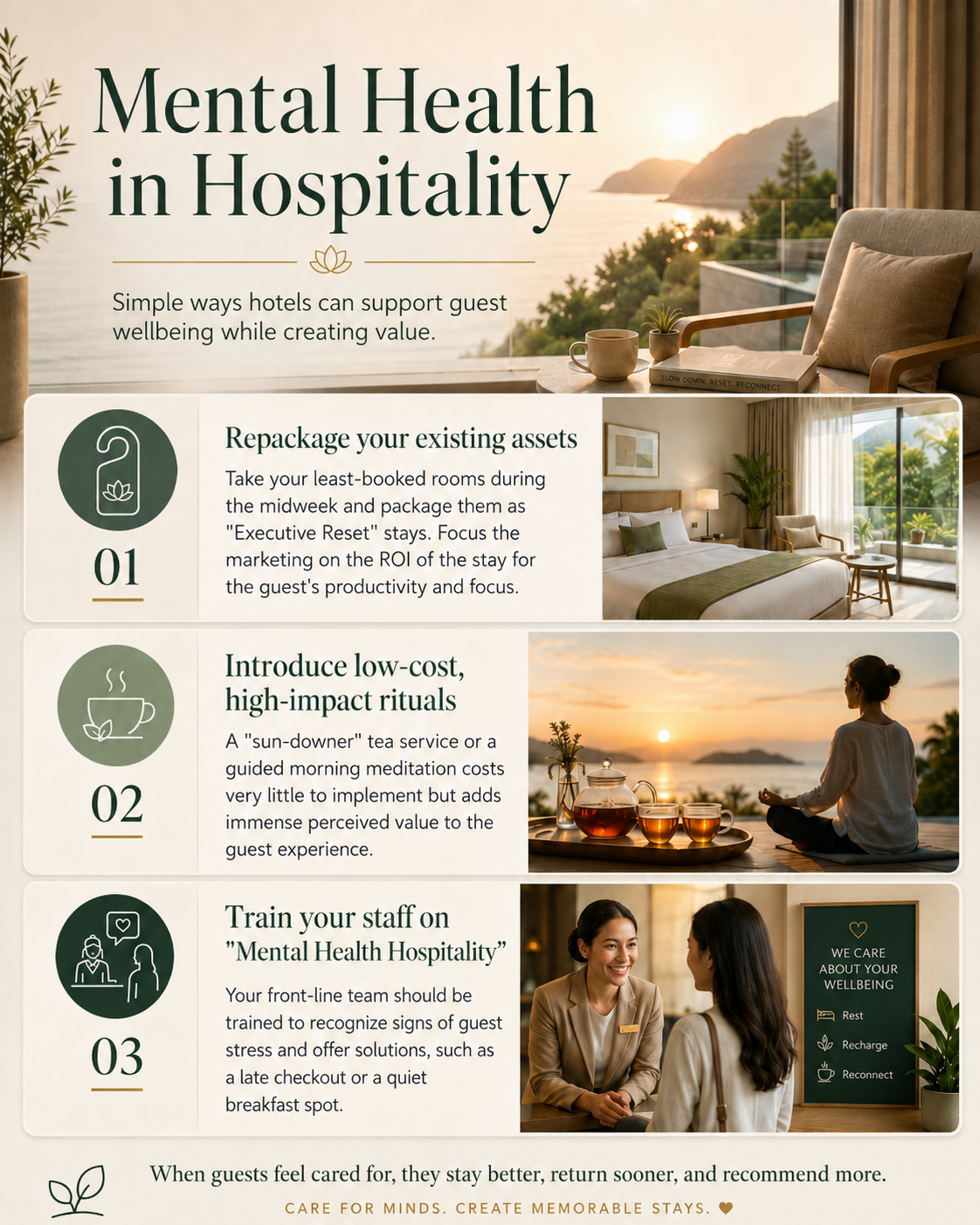
Repackage your existing assets: Take your least-booked rooms during the midweek and package them as "Executive Reset" stays. Focus the marketing on the ROI of the stay for the guest's productivity and focus.
Introduce low-cost, high-impact rituals: A "sun-downer" tea service or a guided morning meditation costs very little to implement but adds immense perceived value to the guest experience.
Train your staff on "Mental Health Hospitality": Your front-line team should be trained to recognize signs of guest stress and offer solutions, such as a late checkout or a quiet breakfast spot.
For those looking to go deeper, designing a signature mental wellness retreat program can unlock entirely new revenue streams. These retreats often fill rooms during off-peak periods and attract a high-spending demographic that values expertise over amenities.
The picture is clear: the most successful hotels of the next decade will be those that realize they are in the business of human optimization. Mental health is the new luxury, and "Calm" is the most valuable currency you can trade in. The question is no longer whether you should invest in mental wellness, but how much revenue you are willing to leave on the table by waiting.
If you are ready to turn your property into a high-yield sanctuary, let's unpack your potential together. You can explore more of our insights on the Elevate Hospitality Collective blog or reach out to see how we can build a custom revenue strategy for your hotel.
